
The Hidden Secret Behind Every Powerful Solar System
Every solar system on a rooftop, from a modest home in Lagos to a sun-soaked farm in California, shares a single secret that determines its true power. That secret is how the panels are connected.
Wiring may not sound exciting, but it’s the backbone of every solar installation. It decides how much power your panels produce, how stable your energy flow remains, and even how long your system lasts.
The International Energy Agency reports that more than 80 percent of small solar systems around the world perform below their capacity because of poor wiring or mismatched configurations. Imagine investing in a solar system that promises free sunlight for decades but delivers only a fraction of its potential , all because of one overlooked detail.
When you understand series vs parallel solar panel wiring, you gain the knowledge to build a system that delivers maximum efficiency, stability, and long-term savings. Whether you are a homeowner, a solar engineer, or a renewable energy student, this guide will help you uncover which wiring method truly gives you more power.
Understanding Series Wiring: The Power of Connection
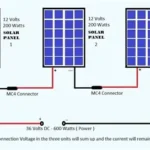
In series wiring, the positive terminal of one solar panel connects directly to the negative terminal of the next, forming a single electrical loop.
This configuration increases voltage while keeping current constant. If each solar panel generates forty volts and you connect four panels in series, the total voltage becomes one hundred and sixty volts, while the current stays the same as one panel.
It’s similar to stacking batteries in a flashlight. Each battery adds to the total power potential, and the device shines brighter because voltage builds up.
This method is especially effective for large-scale systems where voltage needs to be high to reduce energy losses during transmission. Higher voltage means less resistance, which translates to smoother, more efficient power delivery.
The United States Department of Energy has noted that high-voltage systems can reduce transmission losses by up to 30 percent, particularly in systems that use long cables or have to travel large distances to reach the inverter.
However, this setup is sensitive to shading. If one panel in a series chain is blocked by a tree or cloud, its output drops and so does the entire string’s performance. Think of it like a row of holiday lights, where one burnt-out bulb can dim the whole line.
Real-world installers often face this challenge on rooftops where trees, antennas, or chimneys cast shadows throughout the day. Even a single shaded panel can cut total system output by as much as 50 percent. That’s why careful positioning and the use of bypass diodes are essential for maintaining stability in series configurations.
When designed correctly, series wiring delivers incredible efficiency for uniform, sunny environments. It’s simple, cost-effective, and compatible with high-voltage inverters, making it ideal for grid-tied systems.
Understanding Parallel Wiring: Independent Yet Powerful
In a parallel configuration, each solar panel operates as its own energy source. The positive terminals of all panels are connected together, and the negative terminals are connected together.
This means voltage remains the same as one panel, but the total current increases as you add more panels. If each panel produces forty volts and ten amps, four panels connected in parallel will still generate forty volts, but the current increases to forty amps.
Parallel wiring acts like a multi-lane highway. The voltage represents the speed limit, and the current represents the number of cars on the road. Adding more panels is like adding more lanes more cars can travel at once, increasing traffic flow without increasing speed.
This setup is especially useful when panels face different angles or when parts of the array experience shading. Because each panel functions independently, one shaded or dirty panel does not reduce the output of the entire system.
Research from the National Renewable Energy Laboratory (NREL) found that parallel systems can increase total energy yield by 12 to 18 percent in environments with partial shading or mixed panel orientation.
However, there are trade-offs. Parallel systems require thicker cables to handle increased current, and the voltage drop over long distances can lead to energy loss. This can raise installation costs slightly, but the trade-off in reliability often makes it worthwhile, particularly for off-grid systems and complex rooftops.
Real-World Example: How Wiring Affects Output
Consider two identical homes in Nairobi, each installing four solar panels rated at forty volts and ten amps.
Home A connects its panels in series, creating a total voltage of one hundred and sixty volts and a current of ten amps. Home B connects its panels in parallel, creating a total voltage of forty volts and a current of forty amps.
If both homes use the same inverter but experience different shading conditions, their results will vary dramatically. Home A, with a clear, sunny rooftop, will achieve near-perfect efficiency with its series wiring. Home B, with occasional shade from trees, will perform better with parallel wiring since each panel can operate independently.
This comparison shows that the best wiring choice depends not only on the equipment but also on environmental conditions and system goals.Series vs Parallel: What the Numbers Say
Series wiring is all about higher voltage and cleaner transmission. Parallel wiring focuses on current and consistency.
Series systems typically reach efficiencies between 85 and 92 percent under ideal conditions, while parallel systems perform at about 78 to 88 percent depending on sunlight consistency.
Yet, when environmental factors like shading, angle differences, and temperature variations are considered, the efficiency gap narrows significantly. In shaded or mixed-angle installations, parallel systems may actually outperform series setups in total daily energy output.
In other words, series is superior for clear skies, while parallel shines in unpredictable light.
Why Professionals Prefer Hybrid Systems
Modern solar designers rarely rely on one method alone. Instead, they combine the strengths of both in what’s called a hybrid system.
A hybrid configuration groups several panels into series strings to achieve higher voltage, then connects those strings in parallel to boost total current and improve shading tolerance.
This approach gives installers control over both voltage and current, allowing them to tailor systems to each site’s layout and conditions.
The Solar Energy Industries Association (SEIA) found that hybrid systems can increase overall reliability by up to 25 percent and improve energy yield across varying weather conditions. They also reduce stress on individual panels, prolonging system life and inverter health.
Hybrid systems are now considered the gold standard for both residential and commercial installations because they balance efficiency, flexibility, and cost.
Technical Insight: The Role of Inverters and MPPT
Your inverter plays a crucial role in determining which wiring method works best. Modern inverters use Maximum Power Point Tracking (MPPT) technology to adjust voltage and current for optimal energy harvest.
In series systems, MPPT helps balance voltage when sunlight fluctuates. In parallel systems, it regulates multiple input streams to maintain steady performance.
If your inverter supports multiple MPPT inputs, a hybrid setup becomes even more effective because it can manage separate strings independently. This prevents shading on one group of panels from affecting another, increasing overall output stability.
Cost Considerations and Maintenance
From a cost perspective, series wiring tends to be cheaper because it requires thinner cables and fewer connection points. This reduces installation labor and material expenses.
Parallel systems, on the other hand, may require more connectors, junction boxes, and thicker wiring to safely handle higher current. While that adds upfront cost, the investment often pays off in better long-term reliability, especially in environments with inconsistent sunlight.
Maintenance also differs. Series systems are simpler to diagnose but harder to isolate for repairs since one faulty panel affects the chain. Parallel systems make it easier to identify and replace individual panels without shutting down the entire system.
For large installations, maintenance flexibility can save significant time and cost over the years.
Environmental Factors That Influence Your Choice
Choosing between series and parallel wiring depends heavily on your local environment.
If you live in a region with stable sunlight, low shading, and wide-open rooftops, series wiring delivers superior efficiency. But if your area experiences cloudy days, frequent partial shading, or irregular panel placement, parallel or hybrid setups offer far more stability.
Temperature also matters. Higher voltages in series wiring can increase stress on system components in hot climates, potentially reducing lifespan. In contrast, parallel systems distribute stress more evenly across panels, enhancing longevity.
Understanding your site’s geography, shading map, and sun hours per day is essential before choosing a wiring method.
The Science of Efficiency and Loss
Electrical resistance is the invisible enemy of every solar system. When current travels through a wire, some energy is lost as heat.
In series wiring, because voltage is high and current is low, resistance losses are minimal. This is why high-voltage transmission lines can carry electricity across continents efficiently.
In parallel wiring, where current is higher, resistance losses increase. That’s why thicker cables are used , to keep losses under control.
Every 1 percent loss in wiring efficiency can mean significant long-term cost differences. Over a 25-year system lifespan, even a small wiring mistake can translate to hundreds of dollars in lost electricity.
The Future of Solar Wiring: Smarter, Safer, and More Connected
As solar technology evolves, smart inverters, microinverters, and DC optimizers are transforming how panels are connected.
Microinverters, for example, allow each panel to operate independently, combining the benefits of parallel wiring with the high-voltage control of series systems. DC optimizers adjust voltage and current at the panel level, preventing shading from dragging down the entire array.
These innovations are making wiring less of a limitation and more of a design choice. In the near future, AI-assisted energy management will allow systems to dynamically switch between series and parallel configurations based on sunlight conditions in real time.
The Bright Truth About Solar Wiring
There’s no single winner in the battle between series and parallel wiring. The right answer depends on your location, equipment, and goals.
Series wiring offers simplicity, efficiency, and low cost for consistent sunlight conditions. Parallel wiring provides stability, independence, and resilience where sunlight varies. Hybrid systems combine both for the ultimate performance balance.
Even a small improvement in wiring efficiency , just 10 percent can save an average home over 200 dollars annually. Over the lifespan of your system, that’s thousands in savings and a smaller carbon footprint.
Understanding wiring is not just a technical skill. It’s a step toward mastering solar energy and securing a cleaner, brighter future.