
 The year 2025 marks a turning point in renewable energy adoption. Solar panels are more affordable, efficient, and accessible than ever before. Homeowners, businesses, and community projects now face a crucial question: how much do solar panels cost in 2025?
Prices have dropped significantly over the past decade due to technological advances, government incentives, and rising global demand. However, costs still vary depending on location, system size, equipment quality, and installation complexity.
To make an informed decision, it is essential to understand solar panel pricing, the factors influencing costs, potential annual savings, and long-term return on investment (ROI). This guide provides a detailed look at 2025 solar panel costs and helps buyers evaluate the financial benefits of switching to solar energy.
Average Cost of Solar Panels
In 2025, the average cost of solar panels in the U.S. ranges from $2.20 to $3.10 per watt. For a typical 6-kilowatt (kW) residential system, total costs range from $13,200 to $18,600 before incentives.
After applying the federal solar investment tax credit (ITC), which remains at 30% through 2032, homeowners pay approximately $9,200 to $13,000 out of pocket. Larger systems, such as those for commercial buildings, often achieve lower per-watt costs due to economies of scale.
Modern panels in 2025 have efficiency rates of 20% to 24%, generating more electricity with fewer panels. Prices have stabilized compared to the rapid declines seen in the early 2010s, while technology has improved significantly.
Factors Affecting Installation Costs
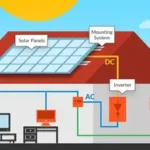
Several factors influence total system costs beyond the panels themselves. Equipment type plays a key role. Monocrystalline panels, the most efficient, generally cost more than polycrystalline or thin-film panels but deliver better long-term performance.
The choice of brand, such as SunPower or REC, also affects the price. Inverters, mounting hardware, labor, permitting fees, and optional add-ons like batteries contribute additional costs. Solar batteries typically add $8,000 to $12,000 to the system price but provide energy storage and backup during outages.
These expenses should be weighed against potential utility bill savings over the system’s lifetime.
Regional Variations in Costs
Solar panel installation costs vary by region. States with strong sunlight and high electricity rates, such as California, Arizona, and Texas, offer excellent returns.
Northeastern states, including Massachusetts, New York, and New Jersey, still have high adoption due to state incentives despite lower sunlight hours. States with weak solar policies or low utility rates may see longer payback periods. In 2025, average payback periods range from 6 to 10 years, shorter than the 12–15 years seen a decade ago.
Annual Electricity Savings
Solar panels provide significant annual savings. Households typically save $900 to $2,200 per year, depending on electricity rates and system size. Rising utility prices make solar a hedge against future cost increases.
Pairing solar with battery storage enables participation in time-of-use (TOU) rate programs. Excess solar energy can be sold back to the grid through net metering, further increasing savings.
Return on Investment (ROI) and Long-Term Value
A well-designed solar system usually delivers an ROI of 12% to 20% annually. Over a 25-year lifespan, net savings can reach $25,000 to $60,000.
States with additional rebates, performance-based incentives, or renewable energy credit markets can further boost ROI. Businesses benefit from commercial-scale installations and accelerated depreciation, achieving strong returns in the first five years.
Solar Panels and Home Value
Solar panels increase home value. Studies show homes with solar sell for 4% to 6% more than similar properties without it. Energy-efficient homes with lower utility costs attract more buyers.
Mortgage lenders and appraisers recognize the added value of solar systems. This makes it easier for sellers to recover their investment when selling their homes.
Financing Options
Financing options in 2025 make solar adoption more accessible. Solar loans, leases, and power purchase agreements (PPAs) reduce upfront costs.
Solar loans allow homeowners to own the system while paying monthly installments, often lower than previous electricity bills. Leases and PPAs have lower entry costs but limit long-term financial gains. For long-term homeowners, ownership remains the most rewarding choice.
Government Incentives and Rebates
Government incentives continue to lower solar costs. The federal 30% ITC remains the most significant. Many states offer additional rebates, tax exemptions, and renewable energy credits.
For example, New York and Illinois provide up to $5,000 in extra tax credits. California offers incentives for solar-plus-storage systems. These programs shorten payback periods and make solar more accessible.
Future Cost Trends
Solar panel costs are expected to remain stable, with gradual reductions due to innovation. Advances in perovskite cells, bifacial panels, and smart inverters will improve efficiency and durability.
Global supply chain improvements will help keep manufacturing costs competitive. In 2025, incentives, reliable technology, and rising energy prices make it an ideal time to invest in solar, locking in long-term savings and reducing carbon emissions.