
The Untold Secret Behind Every Powerful Solar System
Behind every shining rooftop or solar farm that powers homes and industries lies one simple truth , the wiring determines the power.
It’s not just about the number of panels or the size of your inverter. The way you connect those panels defines how efficiently your system captures sunlight and transforms it into usable electricity.
Across the world, millions of solar users unknowingly lose up to 30 percent of potential power because of wiring mistakes. The International Energy Agency found that over 80 percent of small solar installations underperform because of improper configurations.
Understanding how series and parallel wiring work is the difference between a system that merely functions and one that thrives.
How Series Wiring Works: Strength in a Line
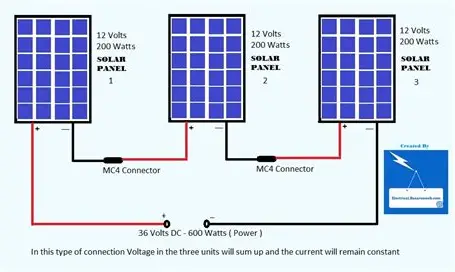
Series wiring is the backbone of most high-voltage solar systems. In this setup, each panel connects end-to-end, with the positive terminal of one linked to the negative terminal of the next.
This simple design builds voltage like stacking batteries. If you connect four panels rated at forty volts each, the total output voltage becomes one hundred and sixty volts, while the current remains the same as one panel.
That high voltage means energy travels farther with less loss. It’s why series wiring dominates in grid-tied systems and commercial setups where efficiency over long cable runs is essential.
According to the U.S. Department of Energy, systems using higher voltage connections can reduce transmission losses by up to 30 percent, improving performance and reducing costs.
But series wiring comes with one clear limitation — shading. If a single panel is shaded, dirty, or damaged, it restricts current flow for every panel in the line. One weak link can drag down the entire chain.
Picture a line of runners passing a baton in a relay. If one runner slows down, the whole team suffers. That’s how series wiring behaves under shade.
Still, in clear, unobstructed sunlight, series wiring performs brilliantly. It’s simple, efficient, and cost-effective.
How Parallel Wiring Works: Power in Independence
Parallel wiring works differently. Instead of linking panels end-to-end, every positive terminal connects to every other positive terminal, and every negative connects to every other negative.
This keeps voltage constant while current increases with each added panel. Four panels producing forty volts and ten amps each will still deliver forty volts, but the total current will rise to forty amps.
Think of it like a highway with multiple lanes. The speed limit (voltage) stays the same, but adding more lanes allows more cars (current) to flow freely.
Parallel wiring is the go-to choice for installations with uneven sunlight. If one panel gets shaded, the rest continue producing power independently.
Research by the National Renewable Energy Laboratory shows that parallel configurations can boost total energy yield by 12 to 18 percent in systems that experience partial shading or panels facing different directions.
The trade-off is that higher current requires thicker cables and more connections, which slightly increases cost and energy losses over distance. But the reliability gained from consistent power often outweighs the cost.
Why the Right Wiring Matters More Than You Think
Your wiring determines not only how much power your panels produce, but also how your inverter, battery bank, and charge controller perform.
Using the wrong configuration for your environment or inverter can limit performance, shorten equipment life, and even cause voltage mismatches that trigger system shutdowns.
For example, a series-wired system may exceed the voltage limit of a smaller inverter, while a parallel setup could deliver too much current for a thin wire to handle safely.
That’s why professional solar designers perform detailed calculations before installation. They consider panel ratings, inverter capacity, distance, and environmental conditions to ensure every connection is optimized for performance and safety.
Series vs Parallel in Real Life
Imagine two households with identical setups — four 40V, 10A panels each.
Home A wires the panels in series, producing 160 volts and 10 amps.
Home B wires them in parallel, producing 40 volts and 40 amps.
Both systems generate 1,600 watts under ideal conditions.
However, when one panel on each roof gets shaded, Home A’s series setup drops to about 800 watts, while Home B’s parallel configuration still produces around 1,400 watts.
That’s the power of independence. Series delivers strength through connection, while parallel delivers consistency through separation.
The best systems often blend both , a combination called a hybrid configuration.
Hybrid Wiring: The Best of Both Worlds
Hybrid systems combine multiple series-connected strings in parallel. This balances voltage and current, ensuring the system operates efficiently under diverse conditions.
It’s like forming small series teams that work independently within a larger network. If one group experiences shade, the others continue performing.
The Solar Energy Industries Association reports that hybrid setups can increase reliability and performance by 20 to 25 percent compared to systems using only one wiring method.
Hybrid systems are now the standard for both residential and commercial installations. They deliver stability, scalability, and efficiency , the three pillars of modern solar design.
The Role of the Inverter: Matching Power and Purpose
Your inverter determines how effectively your wiring configuration converts DC power from panels into AC electricity for your home.
Modern inverters come with Maximum Power Point Tracking (MPPT), a technology that constantly adjusts voltage and current for maximum efficiency.
In series setups, MPPT ensures panels operate at their optimal voltage even as sunlight intensity changes. In parallel setups, MPPT balances multiple inputs to prevent one shaded panel from reducing total power.
If your inverter has multiple MPPT inputs, you can separate groups of panels by roof angle or shading conditions , essentially building a hybrid system automatically.
Cables, Connectors, and Safety
Choosing the right wiring method also affects cable selection.
Series connections handle high voltage but low current, which means you can use thinner cables and longer runs without major loss.
Parallel systems carry high current, which generates more heat and requires thicker cables for safety and efficiency.
Undersized cables cause power loss and may even pose fire risks. That’s why certified solar installers always calculate wire gauge based on system current, length, and environment.
Using quality connectors like MC4 plugs ensures tight, weatherproof seals that resist corrosion and maintain system safety for decades.
How Environment Influences Wiring Choice
Your location and climate play a huge role in determining the best wiring method.
In sunny, open areas with minimal shading like Arizona, Morocco, or Northern Nigeria , series wiring provides excellent efficiency and low loss.
In contrast, areas with frequent clouds, trees, or mixed roof angles ,such as London, Cape Town, or coastal regions , benefit more from parallel or hybrid systems for steady power.
Temperature also affects performance. Series wiring can generate higher voltages, which may increase stress in hot climates. Parallel setups distribute the electrical load, keeping systems cooler and extending component life.
The Science of Efficiency
Every solar system faces one unavoidable challenge: electrical resistance.
Whenever electricity travels through a conductor, some energy converts into heat. The longer the cable and the higher the current, the more energy is lost.
That’s why high-voltage, low-current systems (series) experience fewer losses. Parallel systems, with higher current, experience more resistance but greater flexibility.
Even a 1 percent efficiency loss from poor wiring can cost hundreds of dollars in power over a system’s lifetime. That’s why understanding wiring principles is crucial before installation.
Future-Ready Solar Wiring
The solar industry is evolving fast. With the rise of microinverters and DC optimizers, systems are becoming smarter and more adaptive.
Microinverters let each panel operate independently, converting DC to AC right at the source. This removes the shading issues of series wiring while keeping efficiency high.
DC optimizers take it a step further by adjusting voltage and current at each panel before sending it to a central inverter.
These technologies blur the line between series and parallel — offering the precision of series wiring with the resilience of parallel setups.
Soon, AI-driven solar controllers will automatically switch configurations in real-time to capture every possible watt of sunlight.
Cost, Maintenance, and Longevity
Series wiring is simpler and cheaper to install, requiring fewer materials and less labor. Parallel systems cost slightly more but offer longer-term reliability and easier troubleshooting.
When a series panel fails, diagnosing the problem requires testing each panel in the chain. In a parallel setup, individual panels can be isolated and repaired without shutting down the entire array.
Hybrid systems combine both advantages, lowering costs while maintaining flexibility.
Over a 25-year lifespan, an efficiently wired solar system can generate thousands of extra kilowatt-hours and save homeowners significant amounts on energy bills.