
Electricity prices in the United States have steadily increased over the past several decades, affecting homeowners, businesses, and anyone managing energy costs. The U.S. Energy Information Administration (EIA) reports that the national average electricity rate has grown by about 2.85% per year over the last 25 years, with some states experiencing even higher annual increases.
Rising electricity costs result from factors such as fuel price fluctuations, grid upgrades, and regional energy policies. Homeowners considering renewable energy, like solar panels, can use this information to estimate potential savings and calculate the return on their investment.
In this article, we break down how electricity prices rise each year in the U.S., compare state-by-state trends, examine historical patterns, and explain the main factors driving these increases. This guide will help you make informed decisions about energy use and long-term electricity cost planning.
How Much Do Electricity Prices Increase Per Year in the U.S.?
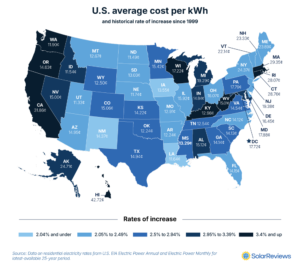
Electricity prices in the U.S. have steadily climbed over the past several decades. According to the U.S. Energy Information Administration (EIA), electricity rates have increased by an average of 2.85% per year over the past 25 years. In 1999, the national average electricity price was 8.17 cents per kilowatt-hour (kWh). By 2024, it reached 16.48 cents per kWh. Looking further back to 1960, the average annual increase was slightly higher at 2.93%.
Every state experiences electricity price changes differently. Factors such as energy sources, industrial policies, and local regulations cause some states to see faster increases than others. Understanding these trends helps homeowners plan for future electricity costs and make informed decisions about energy-saving solutions like solar panels.
Key Takeaways
-
Electricity prices in the U.S. have grown 2.85% per year on average over the last 25 years.
-
States with the fastest price growth include Connecticut, Rhode Island, Massachusetts, Hawaii, and California (3.73%–4.54%).
-
States with the slowest price growth include Louisiana, New Mexico, Iowa, Arizona, and Arkansas (1.94%–2.09%).
-
Recent spikes result from rising fossil fuel costs, grid upgrades, and storm-related repairs.
-
Installing solar panels helps reduce uncertainty, since long-term solar production estimates are more predictable than utility rate changes.
State-by-State Electricity Price Growth
Here’s a snapshot of how electricity prices have changed in some key states from 1999 to 2024:
| State | Annual Increase | 1999 Rate (¢/kWh) | 2024 Rate (¢/kWh) |
|---|---|---|---|
| California | 4.54% | 10.50 | 31.86 |
| Hawaii | 4.53% | 14.10 | 42.72 |
| Massachusetts | 4.40% | 10.00 | 29.35 |
| Rhode Island | 4.13% | 10.20 | 28.07 |
| Connecticut | 3.73% | 11.50 | 28.76 |
| Louisiana | 1.94% | 7.20 | 11.64 |
| New Mexico | 2.03% | 8.70 | 14.37 |
| Iowa | 2.03% | 8.20 | 13.55 |
| Arizona | 2.05% | 9.00 | 14.95 |
| Arkansas | 2.09% | 7.30 | 12.24 |
| U.S. Average | 2.85% | 8.17 | 16.48 |
Note: Some states experience higher-than-average electricity price increases, meaning solar can provide even greater long-term savings.
Factors Affecting Future Electricity Prices
Electricity prices won’t always follow historical trends. Several factors could influence future costs:
-
Global events: Oil and natural gas price fluctuations, such as those caused by the pandemic or the Russia-Ukraine war, can push rates higher.
-
Grid upgrades: Investments to modernize the electrical grid often result in short-term cost increases for consumers.
-
Rising demand: AI data centers, electrification of vehicles, and growing energy needs could raise prices.
-
Renewable energy: Increased solar and wind adoption may stabilize prices over the long term.
Why Knowing Rate Increases Matters
Understanding electricity price trends helps homeowners estimate savings from solar panels. When utilities raise rates, solar owners save more, making solar an effective hedge against rising costs.
Solar quotes often include lifetime savings projections, but it’s important to verify whether installers base these estimates on realistic utility rate increases for your state. Accurate projections help you make informed decisions about your solar investment.
Solar panels can protect you from rising electricity costs. Based on historical trends, Americans can expect an average 2.8% annual increase. Some states have consistently higher rates, offering even more potential savings.
With solar panels lasting 25 years or more, understanding electricity price trends is crucial. Accurate knowledge allows homeowners to calculate realistic savings and confidently decide whether solar is a worthwhile investment for their home.
