

A 100-watt solar panel can generate approximately 100 watt-hours (Wh) of energy per hour under ideal sunlight conditions. However, actual daily energy output varies depending on location, season, weather, and panel setup. In the U.S., a 100-watt panel typically produces between 280Wh and 480Wh per day.
Solar Panel Performance Under Real-World Conditions
A solar panel that is rated at 100 watts is designed to produce up to 100 watts of power when it is operating under perfect conditions. These perfect conditions usually mean bright sunlight directly hitting the panel with no shade, dust, or clouds in the way.
Variations Due to Time, Location, and Installation Angle
However, real world conditions are rarely perfect. The amount of power you actually get can vary quite a bit. When the sun is shining strongly and the sky is clear, a 100 W solar panel can produce close to its maximum output for several hours each day. Factors like the time of year, the location of the panel, and the angle at which it is installed can affect its performance. During the winter months, when the sun is lower in the sky and the days are shorter, the panel will not produce as much power as it would during the summer.
Impact of Weather and Shade on Solar Output
Cloudy weather also makes a big difference. Even light clouds can reduce the power a solar panel produces, while heavy clouds or storms can cause a sharp drop in output. Shade from trees, buildings, or other structures will also reduce the panel’s ability to generate power.
Maintenance and Temperature Effects
Another factor to consider is the cleanliness of the panel. Dust, pollen, bird droppings, or anything else that settles on the panel can block sunlight and reduce the amount of energy it can produce. Regular cleaning can help maintain better performance. Temperature also plays a role. It might seem surprising, but solar panels actually perform better in cooler temperatures. Very hot days can slightly lower the efficiency of a panel, even though there is plenty of sunlight.
Expected Real-World Output
In general, a 100 W solar panel will usually produce less than its full rating when installed in the real world. On an average day with good sunlight, you might expect it to generate enough power to run small devices like a few lights, a small fan, or to recharge batteries for later use. It is not powerful enough on its own to run large appliances like refrigerators or air conditioners.
How to Maximize Solar Panel Efficiency and Maintenance
A 100 W solar panel is a fantastic tool for capturing the power of the sun and turning it into electricity. Whether you are camping, living off-grid, or preparing for emergencies, understanding how to get the most out of your solar panel can make a big difference.
Choose the right location. Sunlight is the energy source for your panel. The more direct sunlight it receives, the more electricity it can generate. Always place your solar panel where it gets full uninterrupted sunlight for as many hours as possible. Ideally, this means facing it toward the sun and avoiding shaded areas caused by trees, buildings, or even passing clouds.
Angle it correctly. The angle at which you set your solar panel is important. Adjust your panel so that it faces the sun directly. Depending on the time of year and your location, you might need to tilt it higher in winter and lower in summer. Some people use adjustable stands to make this even easier.
Keep it clean. Dirt, dust, bird droppings, and leaves can block sunlight from reaching the surface of the panel. Even a small amount of grime can lower the amount of power you get. Check your panel regularly and gently clean it with a soft cloth and water. Avoid using strong chemicals as they might damage the surface.
Use a good battery and charge controller. Solar panels produce energy, but to use that energy when the sun is not shining, you need to store it. A strong, reliable battery will store the electricity for later use. Pair your solar panel with a charge controller, a device that protects your battery from being overcharged or drained too much. This setup helps you use your solar panel safely and efficiently.
Monitor your power usage. Since a 100 W panel has its limits, be smart about what you choose to power. Small devices like phones, laptops, LED lights, fans, and portable refrigerators are good choices. Avoid running heavy appliances like microwaves or air conditioners, which need much more power. Keep track of what you plug in, and you’ll find it easier to stay within your solar panel’s range.
Plan for good weather. Solar panels love clear skies. On rainy or cloudy days, they still work, but they produce much less electricity. On sunny days, charge up your batteries as much as possible to prepare for days when the sun might not be as strong.
Invest in expansion if needed. If a single 100 W panel is not quite enough for your needs, you can add more panels later. Many systems are designed to let you link extra panels together. This way, you can build a stronger solar setup over time without starting from scratch.
What appliances can a 100W solar panel power?
A 100W solar panel powers small electronics and low-wattage appliances. It charges smartphones, laptops, LED lights, and small fans. You can store energy in batteries for later use or run small camping equipment like lights and a portable Bluetooth speaker. While it can supplement larger appliances such as a fridge or air conditioner, it usually cannot run them continuously unless paired with a larger solar system or highly energy-efficient devices.
Small Electronics and LED Lighting
A 100W solar panel can charge multiple devices such as smartphones, tablets, and laptops during the day. It also powers several LED bulbs or a string of camping lights. Proper Solar Panel Installation ensures the panel converts sunlight into usable electricity efficiently.
Small Appliances and Battery Charging
You can run small fans, radios, and portable Bluetooth speakers directly from a 100W solar panel. The panel also charges a battery bank, storing energy for use when sunlight is unavailable. This storage allows better energy management and extends the usability of solar power for daily tasks.
Supplementing Power for Larger Appliances
A 100W panel can provide short-term power to small appliances like a mini-fridge or a portable air conditioner. However, it usually cannot sustain continuous operation. High-wattage appliances, including full-sized refrigerators, washing machines, and ovens, need far more energy than a single 100W panel provides. For these devices, you need multiple solar panels along with batteries and inverters in a well-designed system.
Factors That Affect 100 Watt Solar Panel Energy Production
1. Sunlight Intensity
The stronger and longer the sunlight, the more energy your panel produces. Peak sun hours are key to calculating daily output.
2. Location
Panels near the equator receive more sunlight, which increases energy production compared to panels in northern or southern regions.
3. Time of Year
Seasonal changes affect solar output. Longer summer days and higher sun angles generate more energy, while shorter winter days reduce production.
4. Panel Angle and Orientation
Tilting panels correctly and facing them toward the sun maximizes energy absorption and efficiency.
5. Weather Conditions
Cloudy, rainy, or extremely hot days can reduce the sunlight reaching your panels, lowering daily energy output.
6. Panel Efficiency
Different types of solar panels, monocrystalline, polycrystalline, or thin-film, convert sunlight to electricity at varying rates, impacting overall production.
Calculating Energy Production
Watt-Hours (Wh)
Multiply the panel’s wattage by the number of peak sun hours.
Example: 100W panel × 4 peak sun hours = 400Wh per day.
Kilowatt-Hours (kWh)
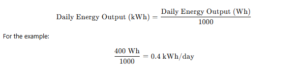
To convert watt-hours to kilowatt-hours, divide by 1000.
Example: 400Wh ÷ 1000 = 0.4 kWh.
Example in Practice:
A 100-watt solar panel in a location with 5 peak sun hours produces roughly 500Wh per day, or 0.5 kWh.
Real-World Considerations
-
Monitoring: Track your panel’s actual energy output to ensure it’s performing as expected.
-
Online Tools: Tools like PVWatts can estimate production based on location, panel type, and setup.
By understanding these factors, you can better estimate how much energy your 100-watt solar panel produces and plan your energy usage accordingly.
How Much Energy Can a 100W Solar Panel Produce Per Day?
A 100W solar panel is designed to produce up to 100 watts of power under Standard Test Conditions (STC). These conditions include sunlight intensity of 1000 watts per square meter, light hitting the panel directly, and a temperature of 25℃ or 77℉. However, actual performance in real-world conditions may vary, and calculations are often reduced to reflect differences between lab settings and actual installation. When a 12V solar panel is rated at 100W, this represents an instantaneous rating. Under STC, the panel produces approximately 18 volts and 5.55 amps. Since watts equal volts multiplied by amps, 18 volts × 5.55 amps = 100 watts.
To calculate energy production over time, multiply the watts by the number of hours the panel operates. For instance, 100W × 1 hour = 100 watt hours. Determining daily energy generation requires considering how many hours of sunlight are equivalent to STC intensity, commonly referred to as sun hours. Morning and late afternoon sunlight is less intense than midday sun, so one cannot simply multiply 100W by the total daylight hours. Sun hours vary throughout the year and by location; for example, a 100W panel in Portland, Maine, at a 45-degree tilt receives an annual average of 4.6 sun hours per day, whereas the same panel in Miami, Florida, at a 25-degree tilt averages 5.2 sun hours. During June and July, Maine may receive more power from the panel than Florida due to longer summer days, despite being farther from the equator.
Calculating Solar Panel Output and Battery Storage Needs
OK, back to the question at hand, what can I power with a 100W solar panel? I need to figure out my worst-case scenario, the worst performing month that I’ll be using the panel. Since for this example I’m using it in Maine during ski season, I need to figure on December. How can I squeeze out as much power as possible in December? By tilting the solar panel steeper so it points right at the low winter sun. I’m going to mount my 100W solar panel at 60 degrees and figure on 3.2 sun hours.
I’ll now take 100W x 3.2 sun hours and get 320 watt hours a day in December. Nothing in real life is perfect, so I have to figure in losses I’ll likely incur, such as voltage drop across the wire, dirt or snow accumulating on the solar panel, losses through the charge controller, etc. I multiply the 320 watt hours times 0.7, figuring on losing about one-third of the power. I end up with 224 watt hours of power that I have made with my 100W solar panel on a December day.
First of all, I need to store it in a battery so I can use it later when I need it. I’m going to use at least a 7 amp charge controller to manage putting the power into a deep cycle battery that can be charged and discharged on a regular basis.
What size battery do I need? I have 224 watt hours that I’m putting in a 12 volt battery. Because watts divided by volts equals amps, 224 watt hours divided by 12 volts equals 18.6 amp hours. Most batteries don’t like being drained more than halfway, so I need a battery that can hold at least twice as much power I will be using, 18.6 amp hours x 2 = 37.2 amp hours.
The power a battery can store changes depending on the temperature of the room. If my battery is going to be as cold as 60 degrees Fahrenheit, I need to increase the size of my battery by 11% to accommodate the cooler temps, 37.2 amp hours x 1.11 = 41.3 amp hours. I’m also going to be converting the DC power from my battery to AC using an inverter, and I’m going to lose about 5% of my power through that conversion, so 41.3 amp hours / 0.95 = 43.4 amp hours.
In Maine in the winter, the sun doesn’t shine every day. I need to figure out how many days without sun I need to store power for. Let’s say I need it to last the weekend without sun. 43.4 amp hours x 2 days = 86.9 amp hours. I’m going to get a group 27 deep cycle battery, that’s 89Ah 12V.
Practical Uses for a 100W Solar Panel in Off-Grid Solar Projects
Now, I can figure out what I can do with that power. I can run my laptop that uses 45W for 5 hours because 224 Watt hours / 45W = 4.97 hours, power 3 of my 10W LED lights for 7 hours and still have a little power left over. I could make a cup of coffee, listen to the radio while reading a book with a 10W light on for 3 hours, and use my laptop for 2 hours. This gives enough information to figure out how to fit this into your situation. You can change the numbers to fit your area and your power needs. If you need help, go to our loads list calculator to see how much power common appliances use, and go to our reference page to see sun hours charts and maps.
How a 100 Watt Solar Panel Converts Sunlight Into kWh Per Month
Sunlight is converted into electricity by solar panels through the photovoltaic effect. When photons from sunlight strike the semiconductor material, typically silicon, in a solar panel, electrons are dislodged, creating an electric current. This direct current (DC) electricity is then converted into alternating current (AC) by an inverter for use in homes, businesses, or solar-energy systems. Understanding this process is essential for estimating solar panel performance and planning Solar Panel Installation effectively.
Calculating Monthly Energy Production
The monthly energy production of a 100 Watt solar panel can be estimated by considering several factors.
Step 1: Determine Daily Energy Output
The daily energy output is calculated by multiplying the panel’s wattage by the average daily peak sunlight hours in a specific location and then accounting for system efficiency losses.
Panel Wattage: For a 100 Watt panel, the nominal power output is 100 W.
Peak Sunlight Hours: This refers to the hours per day when the solar irradiance averages 1000 W/m². This value varies significantly by geographic location and time of year. For example, if a location receives an average of 5 peak sunlight hours per day.
System Efficiency/Derating Factor: Solar panel systems experience losses due to temperature, shading, wiring resistance, and inverter efficiency. A common derating factor used to account for these losses is around 0.75 to 0.85. For this example, a derating factor of 0.8 is applied.
The daily energy output in Watt-hours (Wh) is calculated as:

For a 100 Watt panel with 5 peak sunlight hours and a 0.8 derating factor:

Step 2: Convert Daily Energy Output to kWh
To convert Watt-hours (Wh) to kilowatt-hours (kWh), divide by 1000:
Step 3: Calculate Monthly Energy Production
Monthly energy production is determined by multiplying the daily energy output in kWh by the average number of days in a month, approximately 30.44:

Final Answer
A 100 Watt solar panel, under ideal conditions with 5 peak sunlight hours per day and a system derating factor of 0.8, is estimated to convert sunlight into approximately 12.176 kWh per month. This calculation is critical for engineers and homeowners evaluating Solar Panel Cost Per Watt, Solar Panel Installation, Solar Panel Maintenance, and projecting Solar Panel Prices in 2025. Proper assessment of energy production ensures accurate planning for off-grid systems, home energy storage, or commercial solar projects.
Frequently Asked Questions(FAQ)
-
How Sunlight Hours and Location Impact a 100W Solar Panel’s Output
A 100W solar panel produces electricity based on the intensity and duration of sunlight. The more peak sunlight hours a location receives, the higher the daily energy output. For example, a panel in a sunny region like Arizona or Lagos will generate significantly more power than the same panel in northern latitudes during winter months. Seasonal variations also impact performance, with shorter days in winter yielding lower energy production. Local weather conditions, including cloud cover and rainfall, further influence daily output. Understanding sunlight patterns in your area helps optimize panel placement and maximize energy generation from a 100W solar panel. -
Temperature, Shade, and Orientation: How They Change Your Solar Panel Output
Temperature, shading, and orientation have a substantial impact on solar panel efficiency. Panels perform better in cooler temperatures, as excessive heat can reduce voltage and overall power output. Shade from trees, buildings, or other structures can drastically lower energy production, even if only a small part of the panel is shaded. Proper orientation towards the sun is crucial: panels angled correctly and facing the equator receive maximum sunlight throughout the day. Adjusting tilt angles seasonally can also optimize energy production, ensuring your 100W panel consistently generates electricity near its rated capacity. -
100W Solar Panel Energy for Home Appliances and Small Devices
A 100W solar panel is ideal for powering small appliances and devices rather than full household systems. Typical applications include LED lights, phone chargers, small fans, and laptops. On an average sunny day, a 100W panel can generate approximately 300 to 350 watt-hours, enough to power several LED lights or charge mobile devices multiple times. For slightly larger devices, such as mini-fridges or energy-efficient TVs, a single 100W panel may only provide partial power unless paired with a battery storage system. This makes it perfect for off-grid setups, camping, and emergency energy needs. -
100W Solar Panel vs 200W Solar Panel: Energy Output Comparison
A 200W solar panel generally produces about twice the energy of a 100W panel under the same conditions. If a 100W panel generates roughly 300 watt-hours per day, a 200W panel can produce around 600 watt-hours. This extra output allows for powering larger appliances or storing more energy in batteries. However, higher-wattage panels are physically larger and may require sturdier mounting setups. Comparing costs versus energy needs helps homeowners and off-grid users decide between installing multiple 100W panels or fewer high-watt panels. -
How Efficiency Ratings Affect Your 100 Watt Solar Panel’s Energy Production
Efficiency ratings indicate the percentage of sunlight a solar panel can convert into electricity. A 100W panel with 18% efficiency produces more energy than a 100W panel rated at 15% under the same sunlight conditions. Higher efficiency panels generate more power per square foot, making them ideal for limited roof space. Efficiency also affects long-term energy production and return on investment, especially in areas with limited sunlight hours. Choosing a panel with a higher efficiency rating ensures optimal performance and better energy yields over time. -
Top 100W Solar Panels in 2025 and Their Actual Energy Output
In 2025, leading 100W solar panels combine high efficiency, durability, and reliable energy output. Brands with premium monocrystalline panels often provide around 18–22% efficiency, delivering 300–350 watt-hours per day in ideal sunlight conditions. Polycrystalline panels are slightly less efficient, typically around 15–18%, producing lower daily energy. Real-world factors, such as partial shading, panel angle, and temperature, impact actual output. Understanding these differences helps buyers select the right panel for off-grid use, home backup, or small-scale renewable energy projects.
